
Thoughts on Running a Business Democratically
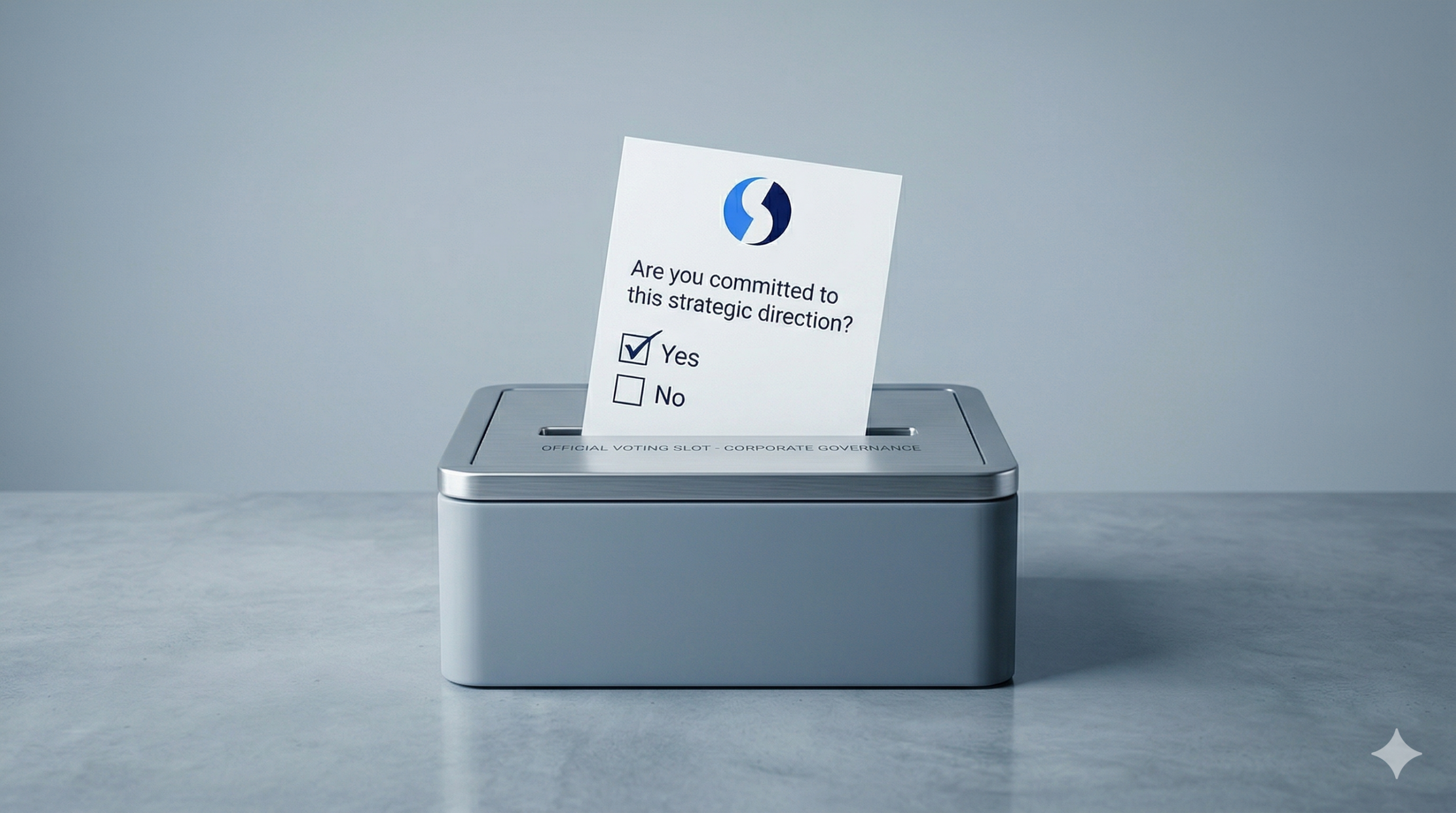
At the end of my last post, I landed on a practical question: what should actually go on the ballot?
Once you give people a real vote, you still have to decide what they are voting on. Are they weighing in on the direction of the business, or on a long chain of connected operating choices like profit targets, reinvestment, reserves, and R&D? That is the part we have been trying to work through as we prepare for our annual vote.
As I have been thinking about that, I had a chance to talk with Kevin Ertell, author of The Strategy Trap. Kevin’s work is rooted in the idea that strategy usually does not fail because people could not come up with a smart plan. It fails because execution breaks down. And one of the things I found most useful in our conversation was his distinction between alignment and commitment. You can get people mostly aligned on a direction, but if they never actually commit to it, the execution problems start showing up later.
That feels very relevant to democratic governance. For me, the point is not to create the appearance of shared decision making. It is to create the conditions for real commitment. In this third post, I want to look at how we have been thinking about the ballot itself.
How Much Should the Ballot Try to Decide?
One of the things we have been wrestling with, especially around capital allocation, is what form the vote should take and how much granularity actually makes sense.
We have run a pretty open-book style of management for years, but the financials we review during All Hands are still fairly high level. It is closer to what you might see if you looked up a public company on Google Finance than a detailed internal budget. We share sales by department, payroll expense, SG&A, and operating profit. For a long time, we kept it pretty simple.
Over the last year, we started sharing a common size financial statement as well. That gives people a bit more detail by breaking payroll into production labor, back office labor, and R&D. Like a lot of businesses, our investment in people is by far our biggest expense, so it felt worth giving that area more visibility. We also pulled our next biggest expense out of SG&A, which is the technology we use to run the business.
If we want people to participate in a meaningful way, they need information that is not just technically available, but understandable and useful. It should help people ask better questions. Where is most of our production labor actually going? Are we getting enough value from tool A, B, or C? If we are going to vote on direction, people need enough context to judge the tradeoffs.
I also think there is something important about familiarity here. We have landed on a level of granularity that people can learn fairly quickly, and that new team members can get up to speed on without needing a finance background. The goal is not to turn everyone into an accountant. The goal is to create enough shared understanding that curiosity can kick in and the conversation gets better.
That matters because democratic governance only works if people have enough context to judge what they are being asked to support. In Kevin’s framing, people do not need perfect certainty in order to move forward. They need enough clarity to say they are mostly there and ready to commit. I think that is an important distinction. The ballot is not trying to prove that a decision is risk free. It is trying to establish whether there is enough shared understanding and belief to move forward together.
At the same time, we do not put a lot of faith in long-range forecasts.
About seven years ago, we built a model that looked five years out. The point was never to predict the future with any real precision. It was to test assumptions and see how the business might behave under different scenarios. We still use that model from time to time when we want to think further out, but its most practical use today is much closer to the ground. We use it to evaluate projected days of cash on hand over the next twelve months and to help guide investment decisions.
That feels more honest to me. The closer the forecast is to the present, the more useful it tends to be. The further out you go, the more you are really talking about direction, not certainty. All models are wrong, but some are useful. What matters is whether the model helps us make better decisions, not whether it creates the illusion that we can see around corners.
Because that model includes sensitive information about team member compensation, access to it has been limited to me, Roy, and our accountant. The rules we have used to manage cash and make investment decisions have mostly been developed by Roy and me over the last eleven years.
So as we move toward a more democratic form of governance, that raises a real question. Does a more democratic system require a different level of transparency than the one we have used up to this point? Do we open the books further?
I think the reason to do that is not transparency for its own sake. It is to improve execution. If the team is going to help shape direction, then they need enough visibility to understand the tradeoffs and enough room to surface concerns before the decision is locked in. Otherwise you can end up with a vote that looks clean on paper, but does not actually produce buy in.
And from a voting standpoint, how far do we go? Do people get a line-item veto over specific expenses or investments? If people hate using a tool like Slack, Confluence, or Monday, should that be something that can make its way onto a ballot?
At some level, I can see the appeal. If shared governance is serious, there is a real pull to put every consequential choice in front of the company, or at least break those choices into smaller parts. But one thing Kevin pushed on in our conversation is that this only works if people feel safe being honest before the vote. If everyone appears to agree too quickly, that can be a warning sign rather than a success. Sometimes the issue is not the strategy itself, but the way it was explained, the facts people think they are reacting to, or a concern that has not been fully surfaced yet. But my instinct is that this can quickly go sideways. Too many signals make it harder to judge direction. At that point, the ballot stops being about strategy and starts looking more like budget line items put up for approval.
So I keep coming back to a narrower approach. Use the ballot to answer the bigger question, and use the comment period to surface the places that need more scrutiny, more debate, and more collaboration. The vote should tell us whether people support the strategic direction of the business and the capital allocation required to pursue it.
“When people commit, they stop thinking about what could have been and start saying, ‘We’re in, and we’re going to make this work.’”
Kevin Ertell
One of the most useful things Kevin said to me was this: when people commit, they stop thinking about what could have been and start saying, “I’m in, and we’re going to make this work.” That distinction matters. Alignment is important, but commitment is what actually changes how people execute. The messier conversations before the vote are where the real learning happens. The questions people ask, the concerns they raise, and the level of engagement they show are all signals. They tell us whether people understand the tradeoffs, whether they trust the process, and whether we are actually building the kind of shared ownership we say we want.
I think that still gives us a meaningful vote. It gives people real influence over the direction, without pretending that every operating decision should be settled by ballot. To me, that feels like the balance we are trying to find. Shared commitment to where we are going, with plenty of room for challenge, input, and better thinking before we get there.

Shilo Jones is the co-founder of StatBid and Poolaroo. Over the past 30 years, he’s built e-commerce businesses and helped merchants grow across multiple categories, with plenty of lessons earned the hard way. At StatBid and Poolaroo, the work is team first and operator led. Poolaroo functions as a living laboratory where we run experiments on our own dime, learn fast, and turn those lessons into practical wins we can share with more merchants. Shilo’s long term focus is sustainable commerce by 2050: thriving wages, circular products by design, and carbon neutral logistics.