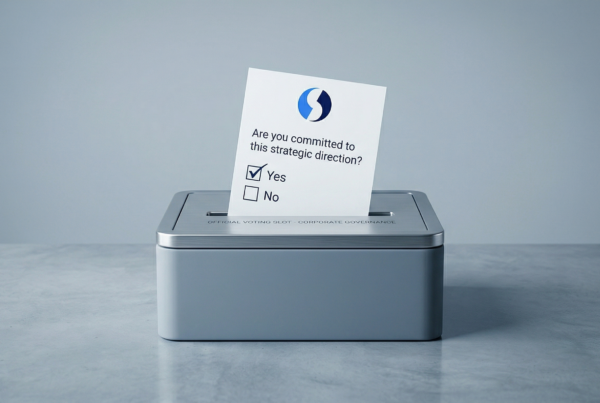

In the first three posts in this series, I have been focused on votes, capital allocation, and what should actually go on a ballot.
Those are important questions. But the more I think about them, the more I think they depend on something even more fundamental: how do you design participation so people can contribute honestly, use judgment, and help shape the business in a way that actually improves execution?
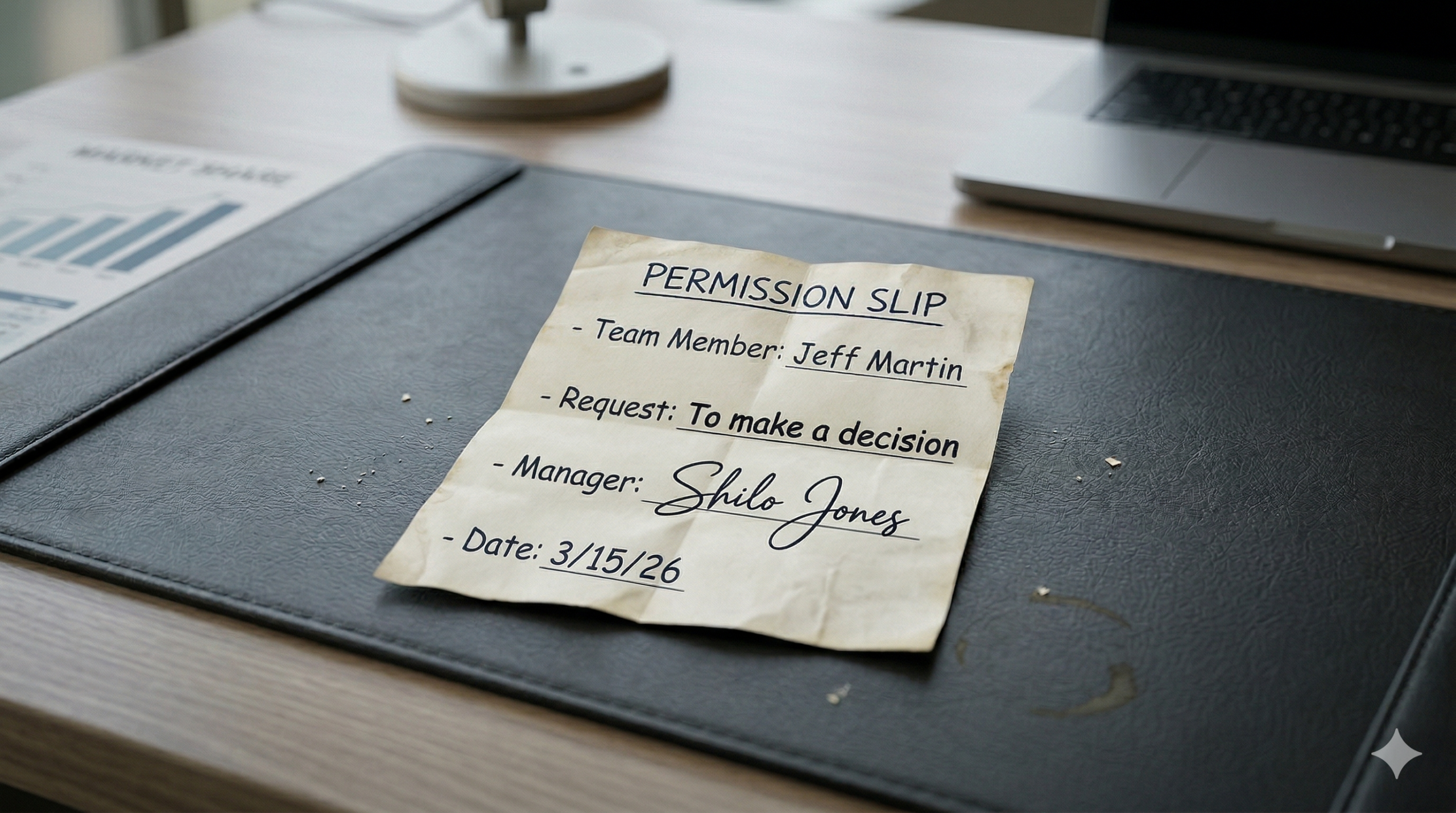
Because when I look at how our company operates day to day, a pattern I keep seeing is not disagreement. It is hesitation. People route decisions upward. They ask permission. They look to leadership to answer the question instead of taking action.
That is not a team failure. It is a signal about the system we’ve built.
Over the last decade or so, we have put real effort into building a culture where problems can be surfaced without blame. No finger-pointing or public shaming. We have tried to build language and mechanics that keep the focus on the problem instead of the person. Credit where it’s due, that work has helped. It has made us better.
But I’m becoming more aware that it’s not the only issue creating headwinds in our culture.
A recent conversation with Jake Rodgers, Executive Director of the The W. Edwards Deming Institute helped bring this out of navel-gazing and into focus. He said that if people keep coming back to the leader instead of handling things themselves, fear may be part of it, but it may also be a lack of clarity. More broadly, participation is a product of how the system is managed. The question isn’t just whether people feel safe to speak, it’s whether the process gives everyone a way in.
Participation has to be designed
Jake made this point with a simple example from education.
Put students in rows in a traditional classroom facing the front of the room and ask a question. Only certain people will speak, the ones most comfortable in that format. Their contributions get noticed. Other people see that and learn something about what participation looks like in that environment.
Put students in a circle. Go around one by one. Each person answers or says “pass.” Now contribution does not depend on volunteering in front of the group. The process itself creates a different entry point.
Change the environment or the context, and you change the way people participate.
That applies to more than the classroom. In any organization, people contribute in different ways. Some are comfortable reacting live while others need time to think. Some are good in a document and some are better talking than typing. Some will challenge openly and others will hold back unless the structure makes room for them.
We have a team member who is an excellent subject-matter expert, knows an enormous amount about how the work should be done. Ask him to document quality standards in Confluence and you get very little. Put him on a call and let him talk through how he sees the work, and he is one of the strongest contributors we have. The question is whether we build a system that lets him contribute the way he actually can, or keep defaulting to the format that works for other people.
The goal is not to force everyone into one mold. It is to build a process different kinds of people can actually use honestly.
That gets harder in a distributed company spread across many countries and time zones. People bring different cultural defaults around authority, disagreement, and what it means to raise a problem. In some contexts, direct challenge feels normal. In others, it does not. We have seen that. Some teams report fewer problems not necessarily because fewer exist, but because presenting them as problems is a different kind of move.
That is one reason I keep coming back to the idea that democratic governance is not only a voting mechanism. It is a process-design problem.
For a ballot to be most useful, people need enough context to understand the question. They need more than one valid mode of contribution, and they need to know how their input can make a difference.
Trust in the process matters
Jake made another strong point: people may trust a leader personally and still not trust the process.
I think that is true of us. People may trust me and still assume that when things get awkward, inconvenient, or slow, we will quietly revert to the old pattern. And if that is what they think, they are not going to lean on the process when it matters.
They may have reasons to think that. If you say something is the process and then abandon it the first time it gets uncomfortable, people learn very quickly what is real and what is decorative. Trust in the process comes from consistency, repeated experience. People need to see what happens when they speak, when they disagree, when they pass, and when they come back later with a different view.
When the process is weak, fear can fill the gap.
That said, while I think “drive out fear” is real work, I am not sure fear is actually what I’m seeing right now. A lot of what looks like hesitation may be that people are not sure what they own, where the line is, or whether the process will hold.
So the question is not just whether people trust me. It is whether they trust the system enough to use it.
Ownership needs boundaries
This connects to something else Jake said that I think we could invest more attention in: boundaries.
There is a temptation to think that if you want more autonomy (or a more democratically governed organization) you should put fewer boundaries on things. I think the opposite may be closer to the truth.
Jake used an analogy that stuck with me.
Researchers watched kids on a playground with a fence around it. The kids played freely, all the way to the edges. When the fence came down, the kids huddled in the center. They did not spread out. They pulled in.
The fence was not limiting them. It was what let them move freely.
Jake Rodger, Executive Director, The W. Edwards Deming Institute
People need clarity about what is tight and what is loose. What do I own? When do I need thought partnership? When do I actually need approval?
Without that clarity, “use your judgment” can turn autonomy into exposure. Uncertainty.
That may be one reason people still ask permission. They don’t lack motivation. The edges are fuzzy. And when the edges are fuzzy, of course people are uncertain.
I have been seeing this in our own company. A lot of what comes back to me is not thought partnership. It is permission-seeking. “Can I do this?” “Should I do that?” “Is this okay?” That means we have not done a good enough job making it clear who can decide what.
If we want more ownership, we cannot just ask people to act with more confidence. We have to make it clear what is theirs.
I have to look at my own patterns too
Jake asked what I might be doing or signaling without realizing it. Tone. Facial reactions. Who gets my attention. Who I tend to trust. Who I keep loading up with work because I know they will get it done.
I can see that in myself.
I lean on the same people. Short term, that is efficient. But it may subtly tell the organization whose voice matters most. It teaches people where decisions really happen. It narrows participation even while I am saying the opposite out loud.
I can see how often I answer questions that aren’t mine to answer. That keeps work moving, but it teaches people to escalate, and once that pattern sets in, it reinforces itself.
That is a design problem, and some of that design may sit inside my own habits.
The shift I think we need
One small example brought this home for me.
One of our team members had a question about a piece of technology he had built. The issue was whether an alert would only apply to a small subset of client accounts, and whether it was still worth moving forward. The older version of me would have answered quickly: yes, no, or not yet.
This time, I tried to push the question back. How would he answer it himself?
I think that was directionally better. But I am not sure it was enough. The goal is not just to refuse to answer. It is to help someone work through the question well enough that next time they come in with a point of view, a rationale, and a way to evaluate the result.
Leadership in this context cannot just be about unblocking people faster. It has to become about helping people build judgment. Otherwise you get speed in the short term and dependence in the long term.
So when I ask, “Why are people still asking permission?” I mean it as a sign that we still have work to do designing participation. We have made real progress on making problems speakable. We have done less to make ownership normal.
My job now is not just to answer fewer questions. It is to help build a system where more people can answer them well without me.

Shilo Jones is the co-founder of StatBid and Poolaroo. Over the past 30 years, he’s built e-commerce businesses and helped merchants grow across multiple categories, with plenty of lessons earned the hard way. At StatBid and Poolaroo, the work is team first and operator led. Poolaroo functions as a living laboratory where we run experiments on our own dime, learn fast, and turn those lessons into practical wins we can share with more merchants. Shilo’s long term focus is sustainable commerce by 2050: thriving wages, circular products by design, and carbon neutral logistics.