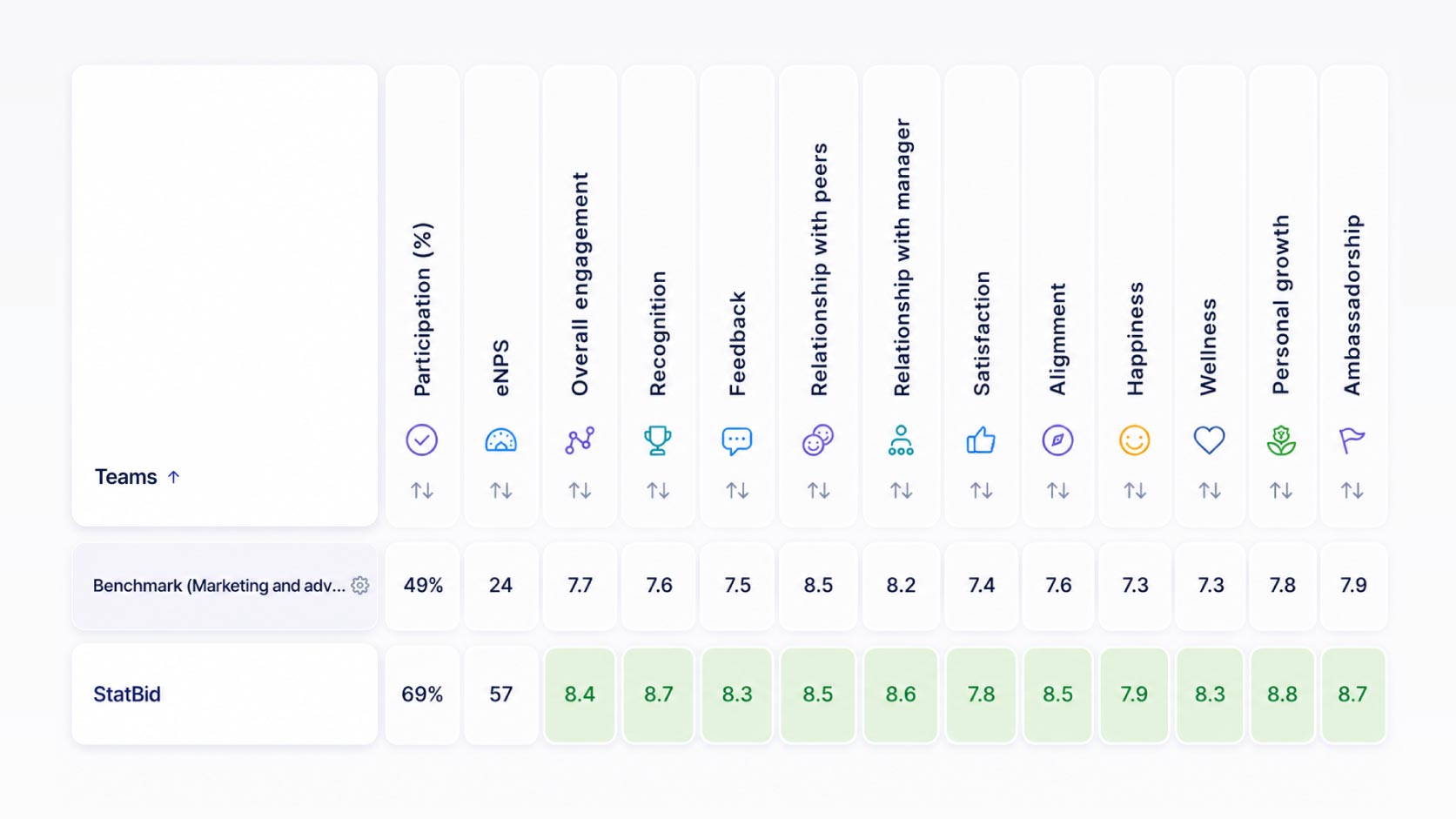

Most Monday mornings start the same way. I log in and respond to our team’s feedback in Officevibe. We have been running it for years, and most weeks the picture is steady with scores generally above 8 out of 10, participation rate up in the high 60s, low 70s, happiness and satisfaction sitting a little lower than everything else but nothing I would call a fire. Nothing flashing red.
A while back I wrote about why people inside a no-blame culture were still asking permission instead of just deciding. This is a different individual question, but it comes from the same family: the readings can look fine while something underneath is not.
Here is the part the dashboard does not show. The business is treading water. Sure, there are macroeconomic factors at play. But for the parts we have more control over, I think two things are true: we underinvested in innovation in the past, and we are still trying to build a company-wide culture of continual improvement.
Most Officevibe survey questions are pretty good at surfacing how people are feeling. They are less useful for showing whether the conditions that make people want to improve are actually present.
For a long time I treated “are people okay” as the question. It is a good question. It just does not explain why a company full of capable people can run smoothly and still not compound the way it should.
What the Data Helped Me See
What started as irritation eventually became something I wanted to understand better. I kept getting pulled into questions I should not have been the one answering. People did not seem to feel they had the room to decide. And the push I most wanted to see, toward steady, continual improvement, kept stalling out. I could feel all of that without being able to name what tied it together.
What helped me make sense of it was a series by David P. Langford on intrinsic motivation, built on Deming’s thinking. Langford lays out five conditions that have to be present for people to be genuinely, internally motivated by their work: control or autonomy, cooperation, support, challenge, and meaning.
I have already written quite a bit about the first of those, autonomy, in the governance posts. But when I looked at our Officevibe data through Langford’s five conditions, two other areas kept showing up, support and challenge.
I took the last year of Officevibe questions, grouped each one into one of the five conditions, and then looked at the results across the company and our available team segments.
The company-wide results still looked broadly healthy. This was not evidence of some broad cultural crisis. But at the segment level, challenge showed up most often as an area worth watching, followed by support. Control showed up in a smaller number of cases. Meaning and cooperation showed up much less often.
Support and challenge seem like the most useful places to look first. Not because they explain everything. We are in a hard market, and no amount of culture work is going to dissolve headwinds we don’t control. But the conditions for motivation are at least something we can work on.
Read through that lens, one signal seemed to stand out. The share of people putting real time into improving how we work, not just doing the work, is low. Over the last 21 weeks we are averaging less than half our team (35%) devoting some of their time to working on the business vs just working in the business. And the people who do it are a small, familiar subset. The dashboard had been signaling all clear. What it had not shown me was how few people were doing the work of making us better.
My first instinct was to start managing the team to improve that number. But I’ve come to realize that instinct, while well-intentioned, isn’t leading in the direction I want.
Signals, Not Targets
It seemed like a clean goal, everyone should spend somewhere between five and ten percent of their hours on improvement work. Tidy. Measurable. I was a little proud of it.
I brought it to a conversation with Jake Rodgers, the executive director of the W. Edwards Deming Institute. His reaction was basically, be careful. The number might be useful as a signal, but it would be a mistake to turn it into a target.
His point is that if you set a quota, people may hit it, but you will not know what it cost you to get there. Better to study the system first. Watch what is actually happening, understand what is producing the results you see, and only then decide whether you even want that number to move.
“If you set a quota, people will achieve it, and you don’t know at what cost. Just study the system. Then talk about whether we want it to improve right now.”
—Jake Rodgers
The five-to-ten-percent target was a quota wearing better clothes. So we should drop the language.
The same logic rules out the “gotcha.” Catching someone not doing the improvement work does not produce improvement. It produces people who got caught, and a system that just taught them to look busy, or find creative ways to juke the stat. If the number is low, the thing to examine is the system that keeps it low, not the people living inside it.
But that creates a harder question: how do you build a culture of continual improvement without flattening it into a number? The moment you make it an explicit target, you risk creating a metric people optimize for its own sake, which is the exact behavior you were trying to avoid.
From Manager to Coach
If we are going to ask people to improve the work, we have to support them in a way that makes that possible. Support is the part we have started to build a mechanism around. Challenge is the part I am less sure how to approach.
For a long time we had no managers at all. Then we added them, because we needed more structure around feedback, support, and coordination. That solved one problem and created another: people pulled into their own silos, and the silos did not add up to a company moving together.
So we made a deliberate shift away from managers and toward coaches. We wanted less hierarchy and more support. At the time, I do not think we fully understood how closely that connected to intrinsic motivation, but that was the direction we were trying to move.
A coach is not just a manager with a softer title. It is a role someone takes on alongside their actual work, the way a strong senior teammate already does, but made more explicit.
I had assumed coaching was the answer to everything. Jake pushed on that, while acknowledging it’s a common trap.
“Early in my career, I used to think coaching was the answer. Everything I saw was a nail.”
—Jake Rodgers
Jake helped me understand that coaching is one method of support, not the whole of it. A good coach first works out where a person actually is, because people are not always clear on what they need in the moment, and then decides whether the moment calls for coaching, for plainly telling someone the answer, or for working it through together. The simple version is meet the person where they are, not where the method assumes they are.
I am not going to pretend we have this figured out. If you ask who at StatBid is an expert at coaching, the honest answer is no one. So we’ve started simply. Every one-on-one runs on three questions: what is going well, what needs to improve, and how can I support you in doing what you need to do? That last one is deliberately not “what do you want me to do for you.”
There is a failure mode that I didn’t even understand in how I approached coaching. You ask questions you already know the answer to, which is just telling someone what to do with a question mark on the end. To get better at avoiding it, we have added a weekly coaches huddle. I should also be candid that the total coaching hours we have logged so far is small, as this is a relatively new process, and Officevibe now asks people how their coaching is landing, so the feedback runs both directions.
The Challenge Problem
Support is the part I can at least see how to work on. Challenge is the one I am less sure how to approach. Langford’s point is that challenge cannot be handed down. It has to be set by the person.
“The only person who can really know what is challenging is the individual.”
— David P. Langford, “The Role of Challenge,” In Their Own Words, The Deming Institute
That connects to research on flow. Mihaly Csikszentmihalyi spent his career studying flow, the state where people are so absorbed in the work that everything else falls away, and two of its conditions are a clear goal and a level of difficulty matched to the person’s skill. Pitch the difficulty too far above their skill and they stall out in anxiety. Too far below and they coast in boredom.
The catch is that the match is specific to the individual, the same task that puts one person in flow will bore or overwhelm the next one. Which is exactly Langford’s point. If the right level of challenge is personal, only the person can set it.
That stays abstract until you try to apply it to a real role. Take a job defined as “content producer.” It is a perfectly clear description of output. It gives the person almost no way to say what about the work would stretch them, what they want to get good at, where the difficulty lives that they would actually find energizing.
If challenge has to come from the person, a role written purely as a list of deliverables quietly removes the place it would come from. I do not yet have a clean way to build challenge back into a defined role without it becoming one more thing assigned from above. That is one of the things we are working through.
For now, three questions are open for me, and I mean them as questions, not as setups I already have the answers to.
First, is participation in process improvement even the right leading indicator? It might be the thing to watch. It might also be a symptom of something further upstream that I should be measuring instead. Maybe the better signal is the number of improvements or experiments people actually run, not the hours they log.
Second, how does a person set their own challenge inside a role that is defined for them? I laid out why I think the standard role description works against it. I do not know what replaces it.
Third, I may have the order backwards. I have been assuming motivation is the lever that produces the habit. What if the habit is the scaffold, with motivation following once people are already in motion?
If you run a company and you have watched any of this play out, especially the parts I am getting wrong, I would like to hear it. That is part of why I am writing this before I have a clean answer.