

Shopify Audiences is a native app available to Shopify Plus merchants that allows you to build and export high-quality audiences directly into your advertising platforms. What makes it different from most audience tools is the data behind it. Instead of relying only on your own customer lists or platform-side modeling, Shopify Audiences uses aggregated, privacy-safe purchase data from Shop Pay users across the Shopify ecosystem to identify people who are more likely to buy from your store.
In practical terms, Shopify is taking real transaction data across millions of buyers, identifying patterns in who purchases what, and then building audiences that reflect those patterns. Those audiences can then be pushed directly into platforms like Google Ads, Meta Ads Manager, TikTok Ads, Pinterest Ads, Snapchat Ads, and Criteo. The setup is straightforward, but the reason it matters is that it improves the quality of the inputs those platforms use to find new customers. As signal quality across platforms continues to degrade, tools that improve inputs like this are becoming disproportionately valuable.
Why This Is Different From Other Audience Strategies
Most brands are already building audiences using tools like Klaviyo, their CRM, or analytics platforms. Those approaches are still important, but they all share the same limitation. They are based on your own data, which is inherently finite. Even strong customer lists and lookalike audiences eventually hit a ceiling, especially as you try to scale prospecting.
On the other side, ad platforms rely heavily on their own modeling. That provides scale, but the signal quality can be inconsistent, particularly as tracking becomes less reliable.
Shopify Audiences sits between those two. It expands beyond your own data, but it does so using confirmed purchase behavior rather than inferred intent. That combination is what makes it useful. You are effectively introducing a broader, higher-quality signal into each platform without giving up the scale that platform algorithms provide.
What Shopify Audiences Is Not
It is just as important to understand what Shopify Audiences does not do.
- It is not a replacement for your existing audiences
- It does not fix weak creative or poor offers
- It is not a shortcut to dramatically lower CPAs overnight
It is a way to improve the signal quality going into your acquisition system. If the rest of that system is working, this tends to make it better. If it is not, this will not solve the underlying issue.
Where the Performance Gains Actually Come From
In practice, Shopify Audiences does not usually show up as a single campaign that dramatically outperforms everything else. The gains are more subtle, but they tend to be consistent and compound over time. The mistake most teams make is evaluating this at the campaign level when the impact is primarily at the system level.
The first place this shows up is in prospecting efficiency. Finding new customers has become more difficult as retargeting pools saturate and lookalikes lose precision. By using purchase behavior from outside your own ecosystem, Shopify Audiences tends to improve conversion rates on cold traffic and bring down acquisition costs at similar spend levels. The improvement is often incremental, but it is measurable and tends to hold as budgets increase.
The second impact is stability. Many teams see performance fluctuate week to week, particularly in channels like Meta. When Shopify Audiences is layered in correctly, campaigns often become more consistent. Learning phases stabilize more quickly, conversion rates are less volatile, and performance becomes easier to forecast. This is not always obvious in a single report, but it becomes clear when looking at trends over time.
The third impact is scale. Every account has a point where increasing spend leads to diminishing returns. Shopify Audiences helps extend that point by introducing new, high-quality users into the system. Even small improvements in efficiency can unlock meaningful growth if they allow you to continue scaling without seeing the same drop-off in performance.
What Kind of Lift Should You Expect?
Most teams evaluating Shopify Audiences want a clear sense of the upside. Shopify’s own case studies from Shopify point to double-digit improvements in CPA and ROAS in prospecting campaigns. We are still fairly early on our adoption of audiences across our clients. However, the early signs look promising and we are excited to continue these audiences continue to drive strong results moving forward.
That said, focusing only on campaign-level results tends to miss the bigger opportunity.
In practice, the more meaningful impact shows up at the system level. Across accounts, introducing Shopify Audiences typically leads to more stable prospecting performance, faster ramp out of learning phases, and the ability to scale spend further before efficiency drops off. Those outcomes are harder to isolate in a single campaign, but they are much more valuable over time.
That predictability is what allows you to scale. Even modest efficiency gains become meaningful if they let you push spend higher without seeing the same level of degradation.
How We Typically Set This Up
The setup itself is straightforward, but the way you deploy it matters more than the initial configuration.
First, you need to enable Shopify Audiences and opt into Shopify Network Intelligence, which allows Shopify to use aggregated data across the network to generate these audiences. Without that, the tool will not function. This does mean you have to update your privacy policy and to obey consent signals because you will be sharing customer information with Shopify. You will also want to make sure you have strong adoption of Shop Pay, as that directly impacts the quality and coverage of the audiences Shopify can generate.
From there:
- Install Shopify Audiences from within your Shopify Plus admin
- Connect your advertising accounts (Google, Meta, TikTok, etc.)
- Generate audiences based on your core product categories
- Sync those audiences into each platform
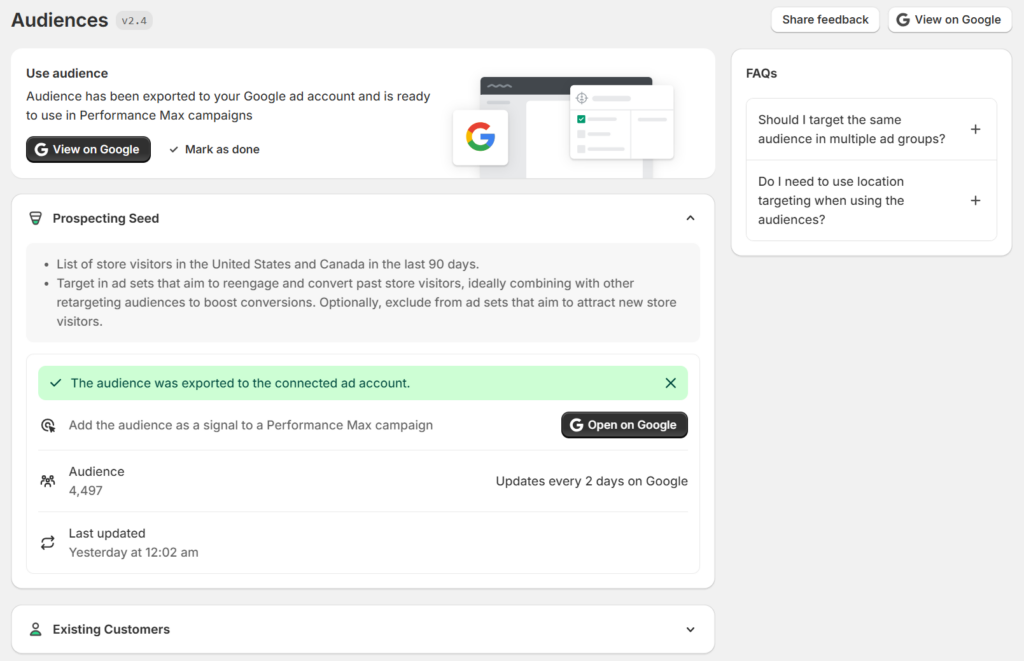
Once everything is live, you do not need to rebuild the account around it. Instead, you introduce Shopify Audiences as a controlled test:
- Run it alongside existing prospecting strategies (not as a replacement)
- Keep creative and budgets consistent for clean comparisons
- Evaluate both campaign-level performance and blended results
The goal is to introduce a stronger starting signal and observe how the system responds.
How This Plays Out Across Channels
While Shopify Audiences can be used across multiple platforms, it is worth being direct about where we spend most of our time. We primarily work with clients on the Google side, and that is where we have seen the most consistent and measurable impact. That said, many of our clients are also using these audiences across paid social with excellent results. More broadly, Shopify Audiences itself is one of the more underappreciated benefits of being on Shopify Plus that many merchants do not fully take advantage of.
Google: YouTube, Demand Gen, and Performance Max
On Google Ads, Shopify Audiences tends to have the most impact anywhere Google is responsible for finding the customer rather than capturing existing intent. That includes YouTube, Demand Gen, and increasingly Performance Max (PMax).
For YouTube and Demand Gen, the impact is fairly direct. These campaigns rely heavily on audience signals, and improving those inputs typically leads to higher conversion rates from cold traffic and better efficiency as budgets increase.
PMax is more nuanced, but it is often where Shopify Audiences becomes more valuable over time, particularly as you scale and the system needs stronger signals to maintain efficiency. PMax already uses a wide range of signals, including your product feed and conversion data. Adding Shopify Audiences does not override that system, but it gives Google a stronger starting point for identifying high-intent users earlier in the process. In practice, we have seen:
- Better early performance when launching new PMax campaigns
- Faster ramp out of learning phases
- Improved efficiency as budgets scale
The biggest mistake we see is trying to force Shopify Audiences into search campaigns or over-constraining PMax. The goal is not to control Google’s system. It is to improve the inputs and let it work.
Meta: A More Stable Prospecting Layer
On Meta Ads Manager, broad targeting continues to perform well in many accounts. Shopify Audiences does not replace that approach, but it often provides a strong complementary layer.
When tested alongside broad targeting, Shopify Audiences frequently produces similar or slightly better CPAs with less volatility. In some cases, Shopify Audiences performs particularly well when paired with newer creative angles that have not yet been fully optimized by the algorithm, helping accelerate the learning curve. In cases where performance is comparable, the real benefit is incremental scale. You can increase total spend without seeing the same level of efficiency loss.
The most important point here is simplicity. Over-layering audiences tends to reduce performance. Shopify Audiences works best when used as a clean signal rather than part of a complex targeting stack.
TikTok, Pinterest, and Other Channels
In channels where native targeting is less mature, Shopify Audiences can have an even greater impact because it improves the starting point. On TikTok Ads, it often reduces wasted spend during early testing and improves conversion rates on cold traffic. On Pinterest Ads, it helps refine who sees your content, particularly in intent-driven categories. On Snapchat Ads, it can help stabilize performance in a less predictable environment, while on Criteo it can extend performance beyond traditional retargeting into acquisition.
When Shopify Audiences Matters Most
You tend to see the biggest impact when:
- You are actively scaling prospecting budgets
- You have enough volume for platforms to optimize effectively
- You are running across multiple paid channels
It tends to matter less for:
- Very low-volume stores
- Accounts not investing meaningfully in paid acquisition
- Situations where creative or offer is the primary bottleneck
One Important Note on Attribution
Shopify Audiences does not always show up cleanly in platform reporting because you are improving targeting inputs rather than creating a clearly attributable conversion source.
In practice, some of the impact shows up as:
- Better blended CPA
- Stronger overall ROAS
- Improved performance across campaigns that do not explicitly reference the audience
This is also why teams sometimes undervalue it. If you are only looking at last-click or isolated campaign reporting, you will miss a portion of the impact. This is why we typically evaluate Shopify Audiences based on blended performance and trend lines rather than isolated campaign reporting.
Why This Works When Other Audiences Plateau
Most audience strategies degrade over time because they rely on limited or increasingly noisy data. Your own customer data only goes so far, lookalikes lose effectiveness as they scale, and platform signals become less reliable.
Shopify Audiences works because it is built on verified purchase behavior at scale. It introduces new, high-quality users into your acquisition system without relying entirely on platform-side assumptions. That makes it one of the more practical ways to improve performance in an environment where signal quality continues to decline.
Final Take
One of the reasons Shopify Audiences is underutilized is that it does not always show up clearly in reporting. If you are looking for a single campaign to “win,” you may miss it. If you are looking at how the system performs as a whole, it becomes much more obvious.
Shopify Audiences is one of the more meaningful advantages available to Shopify Plus merchants, and it is often underutilized. In many cases, it is a hidden benefit of the platform that brands do not fully take advantage of.
It does not replace what you are already doing. It improves the quality of the inputs driving it, which is where most of the leverage is today. The gains are rarely dramatic in isolation, but they are consistent, measurable, and compounding. In a landscape where scaling efficiently has become more difficult, that is often exactly what you need.