
Google has been pushing AI Max for Search campaigns hard. In the pitch, it’s a nearly frictionless upgrade: flip a toggle, let Google’s AI broaden your keyword matching and rewrite your ad copy in real time, and watch conversions climb. The company positions it as one of the most significant changes to Search in years.
After running AI Max on more than 20 accounts, our overall assessment is more complicated. The genuinely new piece (search term matching) works, but only on the right kind of account, and with the right kind of active management. Google has bundled together multiple different features under the “AI Max” headline, and they don’t all work in the same situations. And even where AI Max features do work, they can quietly waste money in ways that aren’t obvious from the dashboard (unless you know where to look).
This isn’t a setting we’d recommend adopting uniformly, and it isn’t one we’d recommend universally avoiding, either. It’s a setting that rewards active management and punishes the set-it-and-forget-it instinct Google’s own marketing encourages.
What’s Actually New About AI Max
The first thing to understand is that AI Max is a bundle, not a single feature. Google’s own explainer page describes it as “a comprehensive suite of targeting and creative features” organized into two main categories: search term matching and asset optimization.
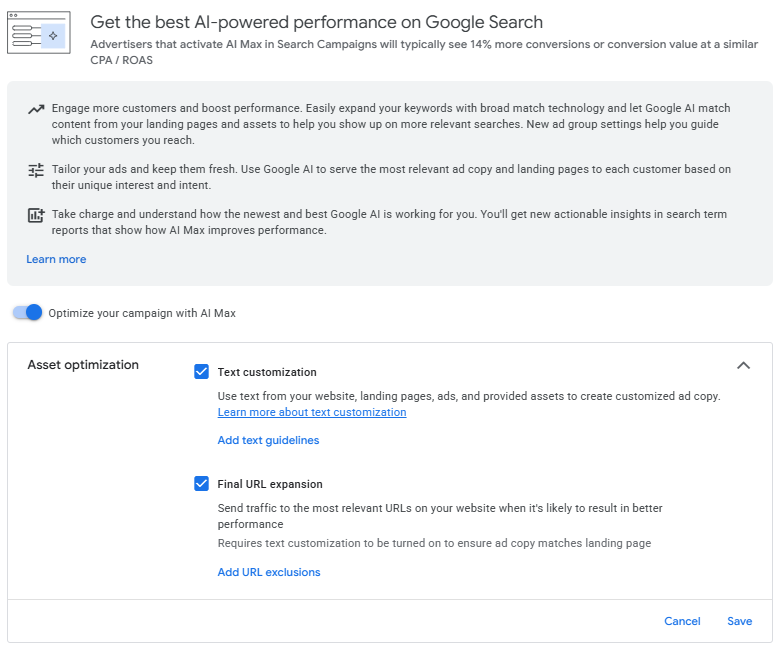
Most of the contents of that bundle aren’t new. Text customization is the feature formerly known as “automatically created assets”. Final URL expansion has existed as a standalone setting. Brand settings and the broad match campaign setting were already available on their own, and Google explicitly calls these out as being “upgraded into AI Max” when you enable it. Bundling them under a new label and a single toggle is a packaging change, not a product change.
The genuinely new piece is search term matching. Google describes it as using “broad match, asset-based, and landing page-based technology” to match your campaign to queries your keyword list doesn’t directly target. That’s the part worth paying attention to, and it’s the part that makes or breaks AI Max in any given account. When this article talks about AI Max helping or hurting performance, it’s almost always talking about search term matching.
The asset optimization side is worth a separate discussion, which we’ll get to below. But the core bet, and the core risk, is search term matching.
Wide Accounts Benefit. Narrow Accounts Don’t.
The single strongest predictor of whether search term matching will help an account is the shape of its converting search-term set.
Accounts with a wide converting-term set, where dozens or hundreds of different queries generate conversions at acceptable rates and there’s likely a long tail of similar queries the account hasn’t discovered yet, are the accounts where search term matching earns its keep. Google has something to work with: a rich signal of what “good” looks like for this advertiser, and room to expand into adjacent query space.
Accounts with a narrow converting-term set, where conversions are concentrated on a small number of exact-match terms and the account has historically needed to ruthlessly exclude everything else, are the accounts where search term matching disappoints. The model reads the limited conversion signal as license to explore broadly, and the exploration costs money the narrow-intent traffic pattern won’t recoup.
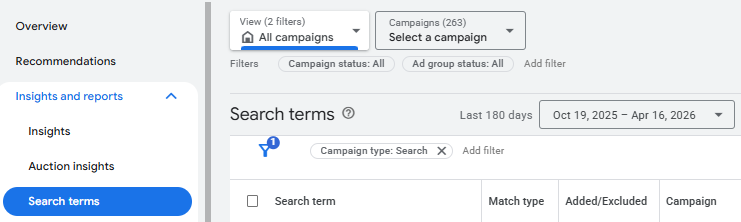
Before enabling AI Max, pull your search terms report for at least the last 180 days, and look at the distribution. If conversions are spread across a long, varied list of queries, you’re a good candidate. If they’re concentrated on a handful of terms you’ve spent years defending, you probably aren’t.
The Asset Optimization Half
The other half of the AI Max bundle is asset optimization, which covers text customization and Final URL expansion. Turning AI Max on turns both of these on by default, though you can toggle them off individually in campaign settings. Our general experience is that enabling both improves performance, but the caveat matters.
If the site has strong, well-written landing page copy and ad assets, text customization tends to help. The model has good raw material to riff on and the rewrites stay on-brand.
If the site’s copy is thin, generic, or inconsistent, or if your ad copy is the product of careful curation to stay within client-approved messaging, text customization is where AI Max most often goes wrong. The automated rewrites amplify whatever’s already on the page, which means weak source material produces weak ads at scale. For accounts where every headline needs human review, leave these off.
Final URL expansion follows the same pattern. It works when the site has strong, well-indexed category and product pages that can reasonably serve a wider range of intents. It struggles when the site’s deeper pages aren’t ready for primetime. It’s also worth knowing that Final URL expansion requires text customization to be on, so the two settings effectively travel together.
The Numbers, With an Asterisk
In the geo-split A/B tests we ran when we first started experimenting with this setting, AI Max delivered roughly 20-30% more search traffic and conversion volume in the tested campaigns*, at comparable ROAS to the control. That’s a real, positive result.
The asterisk is the most important sentence in this article: that lift was measured with active negative-keyword management layered on top. When we left tested campaigns alone, no pruning, no term exclusions, just flip the toggle and walk away, they still tended to grow both spend and revenue. But the spend included a meaningful share of garbage queries that shouldn’t have matched in the first place. Gross revenue up a little, wasted spend up a lot, net efficiency worse.
The junk queries aren’t just random, though. There’s a consistent pattern to what AI Max pulls in, and it tells you something about how the system is making decisions. The most common offenders are informational queries (“what is,” “how does,” “best time to”) and specific competitor brand terms. That makes sense once you think about it. AI Max is trying to identify queries that other searchers paired with the keywords you’ve already targeted, which means it sweeps in the upstream research queries and the sideways competitor-comparison queries of people on the same buying journey. Those queries share an audience with your keywords, but they don’t share intent, and they don’t convert at the same rate. Pruning them is the maintenance cost of the volume lift.
The performance number and the maintenance requirement are inseparable. Anyone quoting you a clean lift figure for AI Max without mentioning the ongoing negative-keyword work is selling you something.
How We Roll It Out Now
Our initial testing was fairly conservative: rigorously constructed geo-split experiments with clear control and variant populations, measured over enough time to establish real confidence. That was the right approach when we didn’t know whether the setting worked at all.
Now that we have directional confidence, our rollout is looser but still disciplined. We typically enable AI Max on a limited set of ad groups within an account, monitor performance and search-term reports closely for the first few weeks, add negatives aggressively as junk queries surface, and expand only once we’re seeing the lift pattern we expect. If performance goes sideways, we pull it back.
This isn’t an A/B test every time, at this point. It’s active portfolio management with a willingness to kill what isn’t working.
Who Should Actually Turn This On
AI Max is not a first-step campaign setting. If you’re still building out a basic account structure, establishing conversion tracking, or hunting for your first reliable set of converting keywords, this isn’t your tool. It compounds whatever foundation you’ve already built, and if the foundation is weak, the compounding goes the wrong direction.
The accounts getting real value out of AI Max share a profile: solid traditional Search performance, enough conversion history for Google’s models to learn from, a wide rather than narrow converting-term set, strong landing page and ad copy as raw material, and a practitioner actively managing negatives and watching search-term reports.
If that describes your account, AI Max is worth testing. If it doesn’t, the honest answer is to fix the foundation first and revisit this setting later.
Google’s framing of AI Max as a flip-the-switch upgrade undersells both its potential and its demands. It’s a useful tool that needs to be tested, not uniformly adopted. The lift is real when the conditions are right, and these conditions aren’t met on every account.