
Your strongest keyword is funding the rest of the campaign’s mediocrity, and the reporting tells you everything is fine.
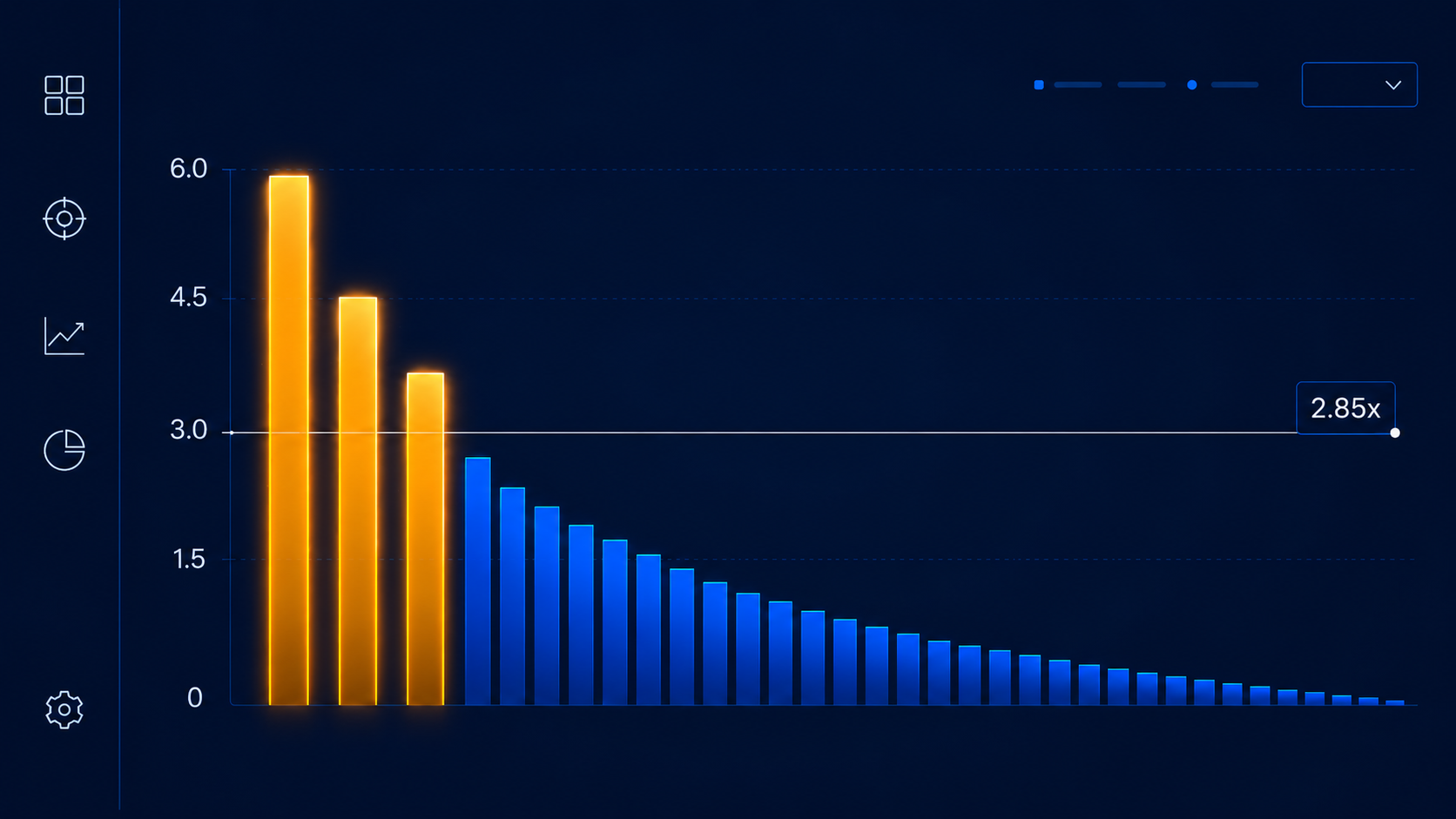
Most merchants running Google Ads have a ROAS target. Many are hitting it. But in almost every account that’s performing close to target, a distribution problem hides underneath the number: two or three keywords generating 600% ROAS, and a long tail of less-valuable terms generating 0–150% ROAS, all averaged together into the target you see on the dashboard.
Smart bidding does its job. It optimizes toward the target you set. But optimization toward an average means your best keywords are almost always underbid. Google is allocating spend across a pool of terms with wildly different economics, and the bid it sets has to work for the whole group.
That’s the problem High Value Keyword (HVK) campaigns are built to solve.
What the Distribution Actually Looks Like
A pattern we see in accounts that are “hitting target” on a campaign-wide basis:
Picture an apparel retailer with two flagship product lines and a broader catalog of accessories. The main Search campaign is set to a 400% ROAS target. Three product-name keywords tied to the flagship items drive 35–40 conversions a month at around 600% ROAS. A long tail of category and accessory keywords converts in the 0–150% range. The campaign average sits right around 400%. Smart bidding is satisfied. The three flagship keywords are leaving revenue on the table; they could absorb 30–40% more budget at the same efficiency.
This is an illustrative composite rather than a single client, but the shape recurs frequently. Once you’ve seen it, you start seeing it in every account where the dashboard ROAS is close to target but a few keywords are clearly carrying the rest.
The fix is to give those three flagship keywords their own campaign, their own budget, and bids calibrated to what they’re actually worth. Raising the campaign-wide ROAS target instead would cut volume on terms that are performing fine.
Who Sees the Biggest Lift
HVK campaigns have the most impact on brand-forward accounts: merchants where customer acquisition is concentrated around a small number of high-intent terms closely tied to the brand or flagship product. If two keywords drive 40% of your paid conversions, the economics of isolating them are usually very clear, and the bid improvement tends to be meaningful.
For large-catalog retailers with thousands of SKUs spread across many loosely-related terms, the math is different. The performance spread exists, but the top terms rarely drive a disproportionate share of total conversion volume. HVK campaigns are still worth building, but the lift is usually smaller.
When to Start Looking
This is a phase 2 build for accounts that already have working baseline campaigns. The trigger is having enough data to know which keywords actually qualify, which requires minimum sample sizes that are higher than most people assume.
Any keyword you’re considering for HVK treatment needs at least 500 clicks or 10 conversions before you can trust its performance data. There’s math behind the 500-click threshold. At a typical 2% conversion rate, it takes roughly 530 clicks before a conversion rate estimate has a margin of error tight enough to act on (less than half the expected rate, at 90% confidence). Higher-CVR keywords need fewer clicks before they’re trustworthy; lower-CVR keywords need more. A keyword with 100 clicks and one conversion looks like it might be a winner. It might also be variance.
Most accounts need 1–2 months of basic campaign performance (PMax, standard Search, or DSA) before HVK candidates emerge. Once top keywords cross that data threshold with clear, consistent outperformance, it’s time to look seriously at breakout.
A keyword qualifies for HVK treatment if it meets any one of these:
Value per click at least 2x the account or campaign average. The keyword is pulling higher-intent buyers, and they’re converting at higher order values.
Conversion rate at least 50% better than the account or campaign average. A 6% CVR keyword in an account averaging 4% CVR is generating materially different economics than everything around it.
10% or more of a campaign’s total conversions from a single keyword. A term this dominant deserves independent controls. Small bid changes have outsized impact on overall account performance.
You’re looking for a small, focused set: typically 5–20 keywords across the entire HVK campaign. If dozens of keywords qualify, a broader structural reorganization is probably the right answer rather than managing dozens of individual breakouts.
The Structure: One Keyword, One Ad Group
HVK campaigns use a Single Keyword Ad Group (SKAG) structure: one ad group per keyword, exact match only, no broad or phrase match variants. This is a structural choice specific to the HVK use case, where the keyword is valuable enough to warrant individual attention. Broader campaigns should use a different structure.
The SKAG structure gives you clean performance data (no ambiguity about which keyword drove which result), ad copy written specifically for that one term, and bid control that doesn’t pull against anything else in the account.
The step most campaigns skip: Before the HVK campaign goes live, the keywords need to be negated from every campaign where they currently live. Skip this and you end up with the HVK campaign and the original campaign bidding against each other on the same term. After negation, run a keyword conflicts check to confirm the negatives are clean.
Close Variants Require Active Management
Google’s “exact match” is no longer truly exact. It now includes close variants: reordered words, terms Google considers semantically equivalent, sometimes phrases that feel meaningfully different from your target. For most campaigns this is a minor nuisance. For HVK campaigns it’s a structural issue, because the whole point of the campaign is precise control over exactly which terms you’re bidding on.
In the first 1–2 weeks after launch, check the Search Terms report every 2–3 days. Any close variant creeping in with worse performance than your exact-match target should be negated promptly. HVK campaigns require more active search term oversight than a standard exact match build used to. That’s worth knowing before you build.
Where HVK Campaigns Earn Their Place
HVK campaigns are a refinement layer for accounts that already have conversion data and a working baseline structure. They aren’t a rescue mechanism for accounts struggling in aggregate. If the account isn’t hitting target across the campaign as a whole, adding campaign complexity before you have strong underlying performance will add noise without clarity.
There’s one exception: accounts with a concentrated core of extremely strong terms buried underneath a large cloud of wasted spend. Sometimes a tightly-marketed brand in a niche category fits this profile: a handful of strong keywords surrounded by broad-match or PMax traffic that’s barely converting. In that case, isolating the core terms can stop the waste on the weak side while protecting what’s working. That’s a specific diagnostic for a specific account shape, separate from the default HVK criteria above.
The Business Case
This is an economics decision as much as a campaign structure decision. A keyword generating 600% ROAS buried in a campaign capped at 400% is leaving margin on the table. Impression share is the part that’s easy to see; margin is the part that’s costing real money. The revenue potential is already inside your account; the bid structure is what’s not collecting it. In our experience, the lift from getting bids right on top terms often exceeds what merchants expect from testing new campaign types or expanding into new keywords.
If your account has 1–2 months of data, you’re hitting target in aggregate, and a handful of keywords are clearly outperforming everything around them. That’s the moment to stop averaging and start isolating.